Humans as a Service
629 words · ~818 tokens · 4 min read
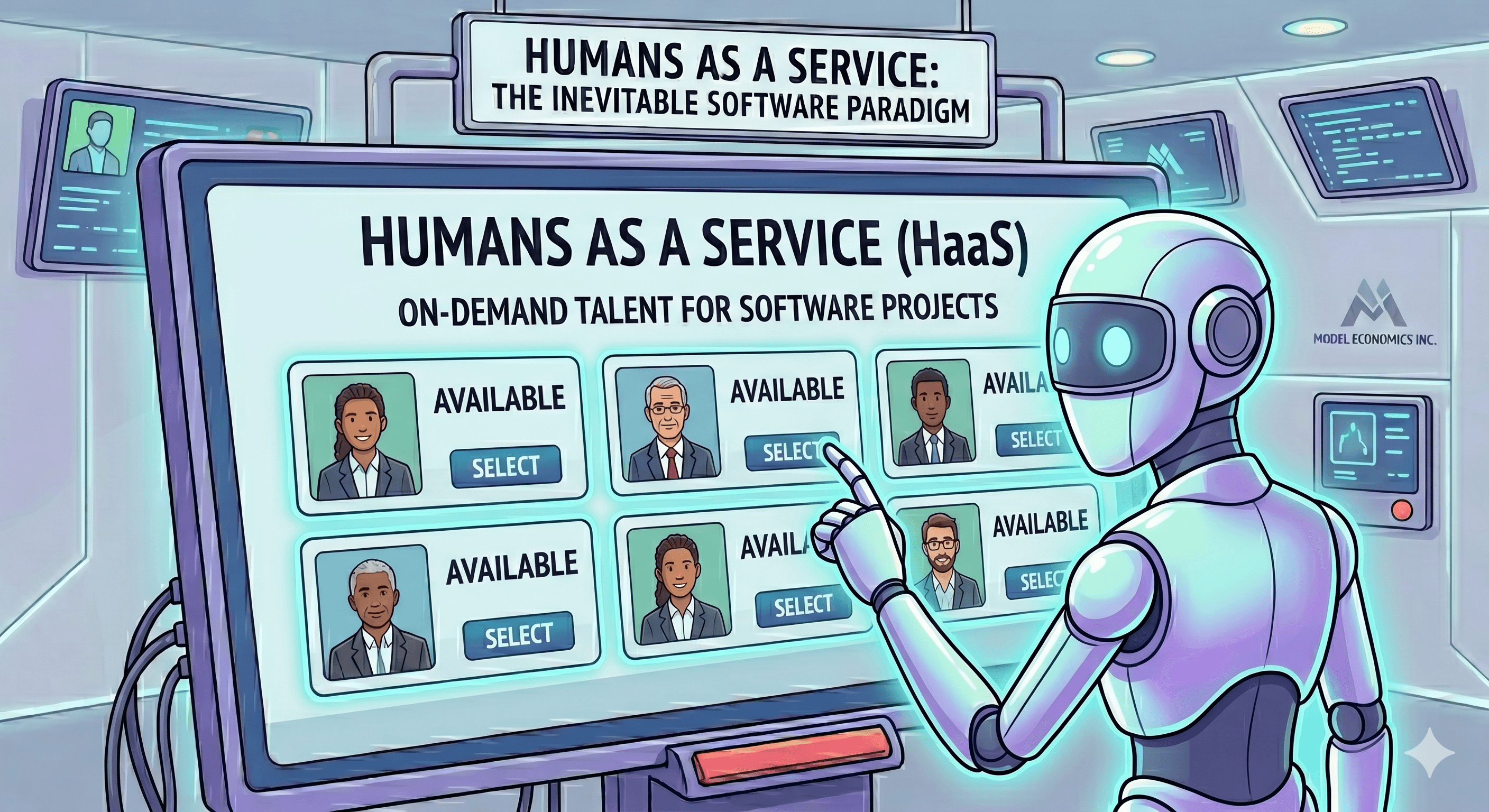
As a Computer Science major, a majority of my time goes into staying up to date on the latest software, technologies, and tools that seem to come up almost every other day: a new AI model, a new productivity tool, and so on. Until now, it has all been about how these tools integrate into our lives as humans, and how humans can use them to become "superhumans."
But seeing the current state of the CS job market, the jobs show an inverse trend: instead of going down as students feared, more and more roles are popping up with titles like "Forward Deployed Engineer" or "AI Engineer": roles tightly coupled to a specific company's product, which focus on automating their internal systems and integrating AI as deeply as possible. Palantir pioneered this role, and now Anthropic and OpenAI are joining in, hiring their own Forward Deployed Engineers. The key thing about these roles is that these engineers are expected to be very familiar, almost experts, with the models their labs ship, and they use those models to build tech demos, products, and software for other companies.
Effectively, we'll move from software engineering teams inside companies to labs providing software engineers on demand. Hence, "Humans-as-a-Service."
This shift is happening because of a few converging factors. AI models have gotten really good at general-purpose coding and reasoning. Even Andrej Karpathy mentioned in a recent interview that he doesn't check the code AI generates anymore. Since January this year, models have gotten remarkably good at "one-shotting" the problems they're given.
Software engineers used to be prompt engineers, then orchestrators, and now they're just giving slight guidance while the model does the task itself. Right now it's still reactive: prompts have to be given for models to start working, but the day these models become proactive, finding and fixing bugs while humans sleep (Claude Code's dream mode is a step toward that), software engineers' role will fundamentally change.
Models are also improving so fast that expertise in any one specific model and its capabilities is a depreciating asset. By the time a company hires and trains a team on Claude Opus 4.6, Claude Opus 4.7 comes out and half of what they learned is outdated, as the model is more capable overall. Renting experts from the labs solves this: their engineers are always on the frontier because that's their job.
The economics start to flip too. A senior SWE in the US costs around $300K/year. A fractional FDE from a frontier lab on a 3-month deployment might cost the same, but ships a lot more. At some point CFOs do the math and the in-house team shrinks.
As models get more capable and more opaque, labs almost have to send humans alongside them. Enterprise software has always worked this way: the product comes with people. SaaS had implementation partners and customer success teams; HaaS just takes it one step further, where the human basically becomes the product. We've effectively moved from writing code to "orchestrating" code, and now, as I see it, we're becoming a service. Engineers, and soon, humans in general, will become services to these software tools. What that means is: as these tools get better at their job, humans will have to adapt to being masters at using them and implementing them in day-to-day scenarios. That basically translates to the future of jobs being "Humans as a Service," and I won't be surprised to see a lot of companies hire fractional experts who are great at the current tools and can always be switched out for another expert. Jobs themselves will become short-lived, objective-focused, modular, and swappable. This is inevitable.
Tech will go from "Software as a Service," acquired by humans, to "Humans as a Service," acquired by AI agents.
Local graph
This post and neighbors one hop away on wikilinks.